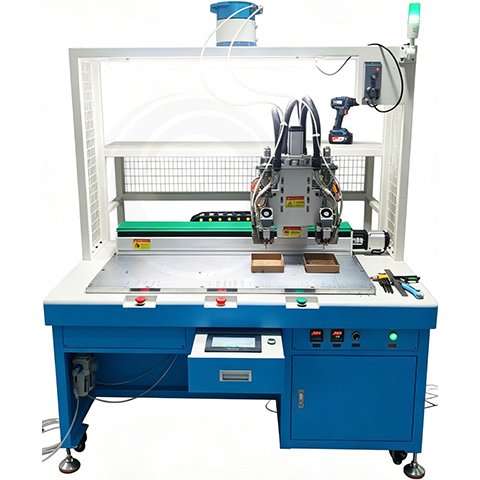
Fully Automatic Dual-Spec Nut Heat Staking Machine | High-Precision Servo Control | Customizable Design
In the production of plastic housings, the stability of nut heat staking directly affects product quality and assembly efficiency. Traditional heat staking Machines often encounter issues in actual production, such as nut misalignment, inconsistent insertion depth, plastic cracking, dry firing, and low mold change efficiency.
To address common challenges in nut heat staking processes, including temperature control, pressure control, positioning accuracy, and material compatibility, our company has independently developed a fully automatic dual-spec nut heat staking machine. It can be customized according to different product structures and is widely used in electrical housings, energy meter housings, home appliance housings, and various plastic parts for brass insert molding processes.
Main Technical Specifications
| Item | Specification / Performance | Remarks |
| Name | Fully Automatic Nut Heat Staking Machine | M3 + M4 dual-head (customizable according to customer nuts) |
| Model | RR-8310-1 | Single-head insertion |
| RR-8310-2 | Dual-head different specifications insertion |
| RR-8310-T2 | Dual-head same specification insertion |
| Overall Dimensions | Approx. 1450 × 1296 × 1780 mm | Subject to actual product |
| Frame | Welded square tube structure | White baked metal paint |
| Protective Cover | wire mesh guard | White baked metal paint |
| Machined Parts | Standard steel: S45C; Special steel: ASP23 | Steel: chrome plated; Aluminum: sandblasted anodized finish |
| Module | Heavy-duty aluminum profile module; fully machined Y/Z axis | High rigidity |
| Positioning Transmission | Taiwan TBI precision ball screw |
| Sliding Components | HIWIN / TBI / FUYU precision linear guides |
| Rotary Components | MISUMI bearing housings |
| Effective Travel | X800 × Y300 × Z100 mm | Can accommodate 4 three-phase base housings |
| Touch Screen | Taiwan Weintek color HMI |
| Electrical Control | Mitsubishi PLC |
| Pneumatic Components | AirTAC |
| Servo Motor | Xinje servo motor system |
| Repeat Accuracy | ±0.05 mm |
| Missing Nut Detection | Inclueded | Effectively prevents missing nut defects |
| Air Pressure | 4–6 kg/cm² |
| Power Supply | AC 220V / 50Hz, approx. 1.5 kW |
| Production Efficiency | 1500–2000 nuts/hour |
| Operator | 1 person |
Equipment Features
Dual-head, dual-spec design for higher efficiency and reduced mold change and handling
This machine adopts a dual-head structure supporting two different specifications of brass inserts, enabling automatic sequential insertion of two different nut sizes.
It effectively solves common issues in traditional equipment, such as:
- Frequent mold change
- Complicated machine adjustment
- Manual handling
- Multiple positioning steps
Significantly improving production efficiency while reducing labor cost.
Independent left/right heads with separate temperature control systems
The equipment is designed with independent left and right heads, each equipped with its own temperature control system.
Advantages include:
- More precise temperature control
- Independent heating for different nut specifications
- Each head can operate separately when the other is idle
Improving overall equipment flexibility and compatibility.
Precision servo control for high-accuracy positioning
The machine adopts high-precision servo motors driving ball screws, combined with PLC control of X, Y, and Z axes for precise positioning.
Compared with traditional pneumatic systems, it offers:
- Higher positioning accuracy
- More stable insertion depth
- Better repeatability
- Higher yield rate
- Improved rigidity
Especially suitable for high-precision plastic housing nut insertion applications.
Rigid L-type aluminum structure ensuring insertion consistency
The machine adopts a high-strength L-shaped solid aluminum structure, which minimizes deformation during pressing.
This ensures:
- Consistent heat staking depth
- Stable product appearance
- Reduced pressing deviation
- Lower maintenance cost
Improving overall process stability.
Automated Process Flow
Automatic feeding
Operators only need to load a batch of brass nuts into the vibratory bowl Feeder. The system automatically organizes randomly oriented nuts into a uniform orientation.
The feeder supports orientation detection (nut ends must have distinguishable geometry or step differences). After identification, nuts are aligned and conveyed into a flexible high-temperature tube.
Nut preheating
After exiting the vibratory bowl feeder, nuts are automatically guided into a high-temperature tube.
The head temperature is adjustable. Once entering the heating zone, nuts are preheated and then transferred to the head waiting for insertion.
Automatic insertion
After heating, brass nuts are automatically pressed into plastic housings by the machine head.
The system supports:
- Insertion temperature adjustment
- Insertion depth control
- Insertion mode selection
- Parameter setting for specific insertion points
Ensuring consistent nut insertion height.
Missing material detection protection
During operation, if no nut is detected, the machine will automatically stop and trigger an alarm.
This effectively prevents:
- Dry pressing (empty insertion)
- Product scrapping
- Overheating damage to the housing
Improving production safety and yield rate.
Application Scope
This equipment is widely used in:
- Laptop plastic housings
- Tablet plastic housings
- Mobile phone plastic housings
- Educational device housings
- Electricity meter housings
- Home appliance housings
- Automotive plastic parts
- Electronic product housings
- Industrial plastic structural parts
Why choose our nut heat staking machine?
- Strong technical capability with an experienced R&D engineering team
- Years of industry expertise enabling efficient problem-solving
- Compared with traditional heat staking machines, we focus more on:
- Temperature stability
- Pressing force control
- Positioning accuracy
- Automation stability
- Long-term continuous operation reliability
- Fast and efficient after-sales support
- Free pre-sales technical guidance
With extensive experience in automation and electrical heating industries, we can provide professional non-standard automation solutions based on customer product structures, nut specifications, and production requirements.
Service philosophy: Fast, accurate, thoughtful, and thorough
The fully automatic dual-spec nut heat staking machine not only improves production efficiency but also effectively solves common issues in traditional processes such as inaccurate positioning, inconsistent depth, and high labor cost.
If you are looking for a high-stability, high-precision nut heat staking automation solution with customization support, please feel free to contact us.


 Photos
 Video
Video